
Web Page Performance: SF Chronicle
As the new template for The San Francisco Chronicle rolls out to a wider audience, I wanted to take a step back and talk a little about web page performance.
Over the years we’ve asked a lot of our web pages, and they’ve become significantly slower as a result. This project gave us an opportunity to hit the reset button
Why should I care?
TLDR; Slow pages can lead to higher bounce rates, visitors abandoning pages before they finish loading, and ultimately fewer opportunities to convert readers into subscribers.
Slow pages also hurt advertising performance. Ads go unseen, viewability suffers, and in some cases impressions never have a chance to fire at all.
Even for visitors who stick around, we lose more of them as they click through articles and grow impatient.
And that’s just on desktop.
Now imagine the experience for our growing mobile audience, many of whom are browsing on slower connections and constrained data plans.
Where are we at?
The primary metrics I focus on are:
- Load Time: The time taken for the web page to be considered fully loaded (lower is better).
- Speed Index: Google’s own measure of performance which is used as a SEO signal (lower is better).
- Page Size: The amount of bandwidth needed to load all the elements of a page (lower is better).
As we’ve run our A/B tests, we’ve seen significant improvements across all three metrics.
The page load-time has dropped by 41% from 28 seconds to 16 seconds. Speed Index has dropped almost 30% from 18,000 to 12,700. The page-size has been reduced by a third from an average of 3MB down to 2MB which is particularly important for readers on mobile connections.
As we continue refining the template, we expect to find further gains. Performance is now a consideration in how we plan and prioritize future development work.
Once this becomes the default template, I expect we’ll see benefits beyond performance metrics alone, including improvements in SEO and reader engagement.
This chart shows the ongoing test results from March and highlights several of the more dramatic improvements.
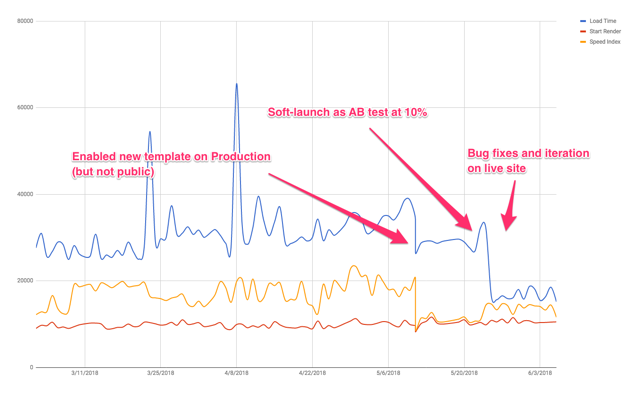
I use an independent testing service, webpagetest.org, configured to simulate a mobile device on a 3G connection. The figures shown represent a rolling average over the previous four days.
The current snapshot as of June 11 is:

This places the Chronicle 32nd on the Article Performance Leaderboard, up from 45th place. Our goal is to break into the top 10.
As this template rolls out to other sites, including the Houston Chronicle and San Antonio Express-News, we expect to see similar improvements. Work done once can benefit all of our properties, and we know there is still room to improve.
As requests for new features and integrations arrive, we’re now looking much more closely at their performance impact.
We need to put the era of vendor promises that a new feature is “just one line of JavaScript” behind us.
It never is.
The benefits of faster web pages are real, measurable, and worth protecting.